
Why Your Brain Struggles in a World That Never Switches Off | At Your Best in the AI Era, Part 1
Dr Jon Finn begins a short series on being at your best in the AI era, using the Lighthouse Brain model to explain why it feels so hard. He argues that better daily habits, not trying harder, build a calmer, more effective mind.
Your own coaching team, helping you manage stress better.
Most coaching programs give you more to do when you’re already overwhelmed. Habit Mechanic is different. Just answer a few simple questions, in a few minutes a day, and your team does the hard work for you.











In this episode
- Dr Jon describes a volatile, post-Covid, AI-accelerated world as the backdrop that overloads brains built for a very different environment.
- He sets out a three-part equation: a well-working brain, focus that creates progress, and the ability to switch off.
- Feeling you never make progress is presented as a bigger driver of burnout than having too much to do.
- HUE scans for threats and quick hits, while Will Power calms HUE and adds perspective, and both are shaped by habits.
Full transcript
Why A Short AI Era Series
Hello, Habit Mechanics, Dr. Jon Finn here. I hope you're having a fantastic week so far. I wanted to do a short series on how to be at your best in the AI era. So here we go. Um this is going to span across multiple episodes. I'll try to keep each one short and to the point, but overarchingly, I want to explore why it has become so difficult to be at our best and look at the the what I'd what I call the the valid and reliable brain science that's that sits behind that.
And so we can really understand the first principle root causes of what's going on. And then I'm going to think about some really practical things we can do to help us to be at our best more often by using that same neuroscience and also behavioural science and also applied performance psychology. So let's be let's start at the beginning.
VUCA Life After Covid
We are living in a world that's described as the VUCA world, the volatile, uncertain, complex, ambiguous world. And then piled on top of that was COVID, the pandemic, and now we're in that kind of post-COVID world where many people acknowledge we're still being affected by what happened during the pandemic. And then on top of that, we've got the AI revolution.
And really, when you add all that together, it just means more change, more speed, more uncertainty. And then we have these global events going on that affect our fuel price, fuel prices, you know, our heating bills, our uh mortgage payments, uh, the cost of living generally. Uh, we're worried about our young people and how they're developing. So just we've just got this change going on at a speed that we've never experienced before, and it's overwhelming.
We have this technology in our pockets that, as court cases are now ruling, has been designed to addict us. Um so the world's complex, no doubt, and more and more people report that it's harder than ever for them to be at their best, to feel good about themselves, to feel like they're making progress in their lives.
Mental Energy, Progress, Burnout
And that's quite a good starting point if we want to understand why it's difficult to be healthy, happy at our best, is to start thinking about what do we need to do to be healthy, happy, and at our best. And for me, it's it's a simple equation. The first thing you need to do is get your brain working really well so you can feel good, so you can um feel like you have mental energy, feel like you're not constantly drained.
Um, you can you've got the mental resources to put perspective on things, um, to be focused and get done what you need to get done so you can switch off and relax at the end of the day. But it's a three-part equation. So the first thing is you've got to get your brain working well, which means good sleep, good diet, good exercise, good social relationships and connectivity, so you've got a healthy functioning brain.
And then what that allows us to do is actually turn up so we can be focused and get done what we need to get done, and that allows us to make progress on the important things in our lives. We know that many uh big sets of data show the number one cause for burnout isn't not having too much to do, it's feeling like you're never ever making progress, no matter what you do.
So, whatever you do, it doesn't actually result in you uh achieving the thing or getting closer to achieving the thing that you want to achieve. So if our brain is working better, we've got more mental energy every day to put into and focus on what we want to achieve, and that allows us to achieve. And achieving gives us a sense of um eudaimonia, gives us a sense of growth, and that then becomes a self-fulfilling loop.
So then it's easier to switch off and relax and look after your brain. Well, so for me, the equation of what you need to do to be healthy, happy at your best is pretty simple. Doing it is a different story, and to understand why it's difficult to do it, we've got to understand the mechanics of our brain.
Meet The Lighthouse Brain
So many of you know that inside tougher minds and the hype mechanic approach, we have three core brain models and they ratchet up in complexity. Um, we we can talk about the brain in pure neurobiological terms at one end of a continuum. The other end we talk about the lighthouse brain, which is a scientifically based model of our brain, but just in a in a digestible way to understand.
So we're gonna start with the lighthouse brain. So we've all got these lighthouse brains operating in this VUCA post-COVID AI revolution world. And our brains are not new technology, they're ancient technology. Homo sapiens, our species, has been around for over 300,000 years, and our brains didn't just appear out of thin air 300,000 years ago. They were evolving, they've been evolving for millions of years.
Um, so the architecture in our in our brain, although it's highly complex, you can think of it there there are two core networks at work. You've got the network in the front of your brain, your prefrontal cortex, and then you've got the network, the big dominant network in the middle of your brain called the limbic regions. Anyone who calls it a system, beware.
It's not if they call it a system, they don't know what they're talking about. We don't know enough about the limbic regions to call it a system yet. That's an outdated term. Anyway, so the lighthouse the lighthouse brain goes like this.
HUE Scans For Threats
So imagine you have a lighthouse in your brain, two characters live there. So you have HUE, H-U-E, that stands for your horribly unhelpful emotions, and you have Will Power. So it's like you've got this little team in your brain. Um, HUE's job is to run the beam of light, and HUE represents these what I mentioned as the limbic regions, and its job is to use that beam of light to first of all look for threats, problems, worries, mistakes, not just in the here and now, but also mistakes or worries or problems you may have experienced 10 years ago or last night, or what might be coming up in the future that's going to be problematic for you, or that might cause you stress or worry.
So it's using that beam of light to look for threats and problems and worries. Um, and because of how Homo sapiens have evolved, one of the big things it's it's worried about is do the people that I need to like me in my life will they like me? We call it social status. So, what will they think of me if I do this or if they find out I did that, or whatever it is.
So um problems and worries are often driven by HUE's subconscious judgments on the damage to your social status by actions that may or may not have occurred because your HUE can make things up, it projects the worst-case scenarios, it interprets events often in the worst possible way, and the way that you're interpreting that particular event uh may might be that you're the only person thinking of it in that way, and everybody else is completely fine by it.
But you get the idea, so you've got this constant um presence in your brain that is designed for threat detection.
Short Term Hits In Your Pocket
When there are no obvious threats, were his problems to to pay attention to, HUE's next instinct is for short-term gratification to pick up the phone, to have the piece of cake, to watch the next episode on Netflix, just to do whatever you need to do to feel good in the moment. And we're living in a world where that's it's easier than ever before to get that hedonic um short-term hit.
So HUE is in charge of the lighthouse, the beam of light, and the other character, Willpower, controls the network that lives in your prefrontal cortex. So willpower's job is to mentor HUE and to calm HUE down. So when HUE is a bit angry or a bit annoyed, and you become consciously aware of it in your prefrontal cortex, then you can use your willpower to calm down HUE and to get HUE to put perspective on things and um not get fixated on the threat, the worry, the problem.
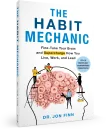
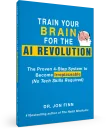
So if you've read Train Your Brain for the Air Revolution or The Habit Mechanic, you'll be familiar with those characters, and what we want to do if we want to become
Willpower, Habits, Brain Training
habit mechanics is understand the characters and then start to build a healthier relationship between willpower and HUE, and we can absolutely do that. But the thing that we need to recognise is that we don't do it by magic, we do it by building new habits because most of what we're thinking, most of what we're doing, is not conscious, it's subconscious, it's in other words, it's a habit.
So when I say don't think of a white elephant, you don't have to, it's already in your brain. That's how automatic our thinking processes are. So that's the lighthouse brain, and and this is what's driving um what we think, how we feel, how we perform every day. And of course, what's happening in this VUCA post-COVID AI revolution world is there are more threats, more problems, more worries than ever before to for HUE to pay attention to.
And remember, you get good at what you practice. So if you're practicing worrying and being inattentive because you're worried and beating yourself up, then you get better at those things because that network, the limbic region network, is getting stronger and stronger and stronger, and the willpower network in the prefrontal cortex is being weakened. So that's the good news is that however you're feeling, however good or bad it is, however poorly or well you think you're performing, we can do better because we understand our brain.
Simple Daily Tools Beat Theory
Our brain is a physiologically adaptive system, it has a set of operating rules, and we know what the operating rules are. And the key thing that we've learned working with over 20,000 people over 25 years now is that what we need is not just a science-based story about how our brain works, we need simple practical things that we can um use every day in our life so that we've got a much better chance of building a helpful relationship between willpower and HUE.
HUE's not your enemy, it's your best friend, you need it on your side. So we've got to um work out the simple practical things we can do every day to make it easier for us to get our HUE nice and calm. So calm HUE, better you, and you're kind of the third person in this team. So you've got HUE and you've got willpower, and you're trying to balance this relationship between the two, but just knowing what they are is not enough to do that.
Next Steps To Calm HUE
So, in the next episode, I'm going to talk about the first thing that we need to understand if we want to build a better relationship between our HUE and our willpower.
More episodes
Ready to perform at your best?
